
The arrival inspection on a part-load has to happen before the pallets are put away, not after the first customer complains. Almost every claim that fails does so for one of two reasons: the buyer sold or moved the goods before recording their condition, or the buyer gave notice after the contractual window had closed. Both are avoidable with a routine that takes about 90 minutes on a shared reefer holding four to eight pallets.
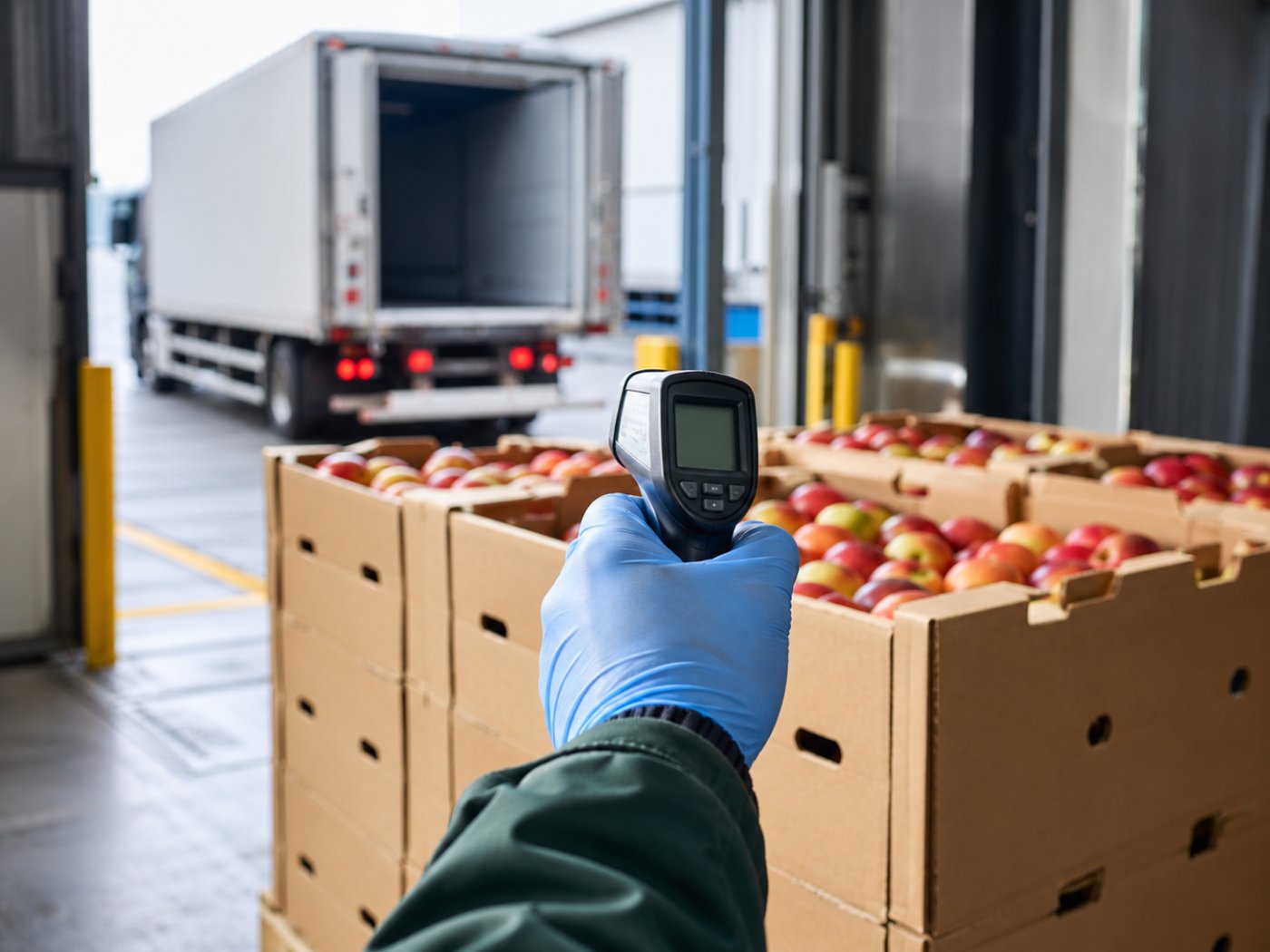
The arrival inspection routine, step by step
| Step | When | Tool | Evidence it creates |
|---|---|---|---|
| Photograph the seal and number | Doors still closed | Phone | Seal integrity against the bill of lading |
| Photograph the stow | Doors just opened | Phone | Pallet condition, collapse, shifting, wet cartons |
| Take pulp temperatures | Before unloading | Probe thermometer | Door end, middle and front, 3 readings each |
| Recover the data logger | During unloading | Logger, USB or app | Full temperature trace, port to port |
| Count pallets and cartons | During unloading | Packing list | Shortage or overage per line item |
| Weigh a sample | Within 4 hours | Calibrated scale | 10 cartons per line, net against declared |
| Cut and taste | Within 4 hours | Knife, refractometer | Brix, internal defects, maturity |
| Score defects by percentage | Within 12 hours | Spec sheet | Defect counts against contract tolerance |
| Give written notice | Within 24 hours | Email plus WhatsApp | Timestamped notification inside the window |
Why pulp temperature comes before everything else
Fruit warms quickly once the doors open, and a reading taken two hours into unloading tells you about your dock, not about the voyage. Take nine readings, three each at the door end, the middle and the front bulkhead, and write them down with the time. If the door end is 4 C warmer than the front on a mixed reefer, that is a stow and airflow problem worth raising even when the fruit is sound, because the next container will be loaded the same way unless somebody says so.
Record defects as percentages, never as adjectives
A note saying the fruit is soft is not actionable. A note saying 18 of 100 fruit drawn from four cartons across three pallets showed soft-nose against a contract tolerance of 5 percent is actionable, and it settles in a day. Draw the sample across pallets rather than from one, photograph the whole sample laid out with a scale reference, and keep the affected cartons intact until the supplier has responded. The specification clauses that make this possible are covered in writing a product specification for a part-load.
Weigh before you accept the invoice
Ten cartons per line item on a calibrated scale takes ten minutes and either confirms the invoice or gives you the number to query it with. Some loss between packing and delivery is normal and the contract should carry a tolerance for it. Reconciling the figures is set out in weights and invoicing on an Egyptian part-load.
The notice window is shorter than most buyers think
Most Egyptian supply contracts require written notice of a quality issue within 24 to 48 hours of discharge, with photographs. Miss it and the claim is normally lost regardless of how bad the fruit was, because the supplier can no longer distinguish transit damage from what happened in your cold room. Send a short factual email with photographs attached inside 24 hours even when the assessment is incomplete, then follow up with the full report. What happens next on a shared container is described in how a part-load claim is handled.
Peivana is a supplier, not a neutral surveyor. This routine reflects what we ask our own buyers to do, because a well-documented arrival is settled faster than a disputed one.
For an arrival inspection template matched to your specification, or to agree notice periods and tolerances before your next part-load, message Peivana on WhatsApp at +20 10 9911 1918. Quotes and specifications are issued the same working day.