
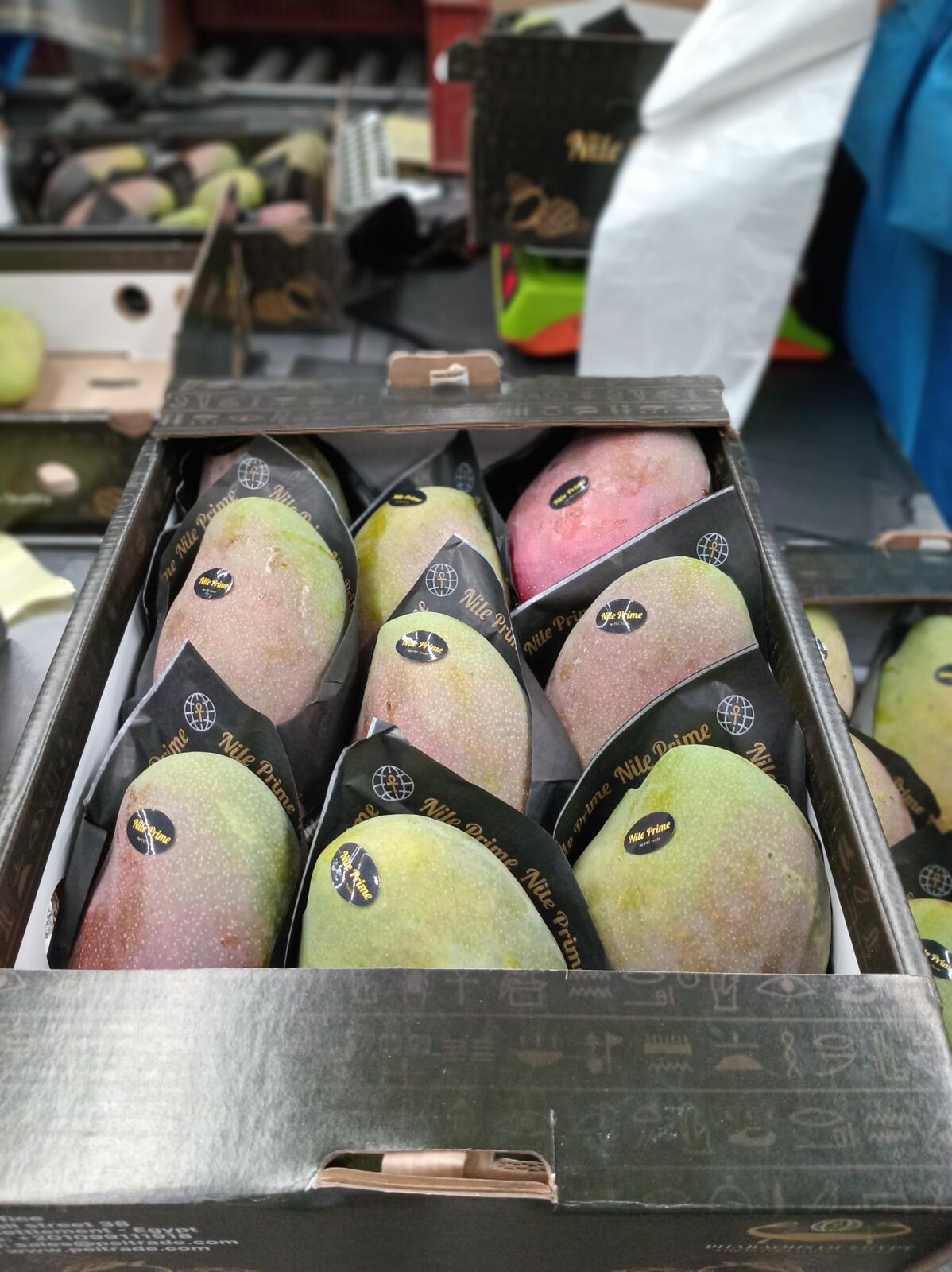
The Egyptian mango season is in its strongest stretch right now. Kent is finishing, Keitt is at peak and will run through September, and Naomi is available in moderate volume. For a distributor moving one or two pallets a week rather than a full reefer, this is the point in the calendar where mango is easiest to source and hardest to plan, because everyone wants it at once.
What a mango part-load actually looks like
The practical minimum on mango is a half pallet, roughly 30 to 35 cartons of 4 kg, or about 120 to 140 kg net. Below that the handling cost per carton stops making sense. A full pallet is 60 to 70 cartons of 4 kg, around 240 to 280 kg.
Most mid-size buyers take two to four pallets of mango and fill the rest of the container with other products. A 40ft high cube reefer holds 20 pallets, so four pallets of mango leaves 16 for everything else.
The temperature constraint is the real limit
Mango is the awkward passenger in a mixed load. It carries at 10 to 12 degrees Celsius. Most of the products a mid-size buyer would naturally pair with it carry much colder. Citrus wants 4 to 6 degrees. Table grapes want 0 to 1. Green beans want 6 to 8. Pomegranate wants 5 to 7.
Setting a shared container to 6 degrees to accommodate citrus will give the mango chilling injury, and chilling injury on mango does not show at loading. It appears as grey lenticel spots and blotchy, uneven ripening days after the buyer has accepted the fruit. This is the single most common way a mixed mango load goes wrong.
The products that genuinely share a reefer with mango at 10 to 12 degrees are guava, fresh dates in the early stage, some pepper and cucumber lines, and other tropical fruit. Our note on reefer set point conflicts in mixed containers lists the full compatibility picture.
Specifying the fruit
On a part-load the specification matters more than on a full container, because you have no volume to average out variation. Fix three things in writing.
First, variety. Keitt and Kent are different products with different shelf behaviour and should not be substituted for each other without your agreement.
Second, count. Counts 6 to 8 in the 4 kg carton are large fruit for wholesale display. Counts 9 to 12 suit retail and pre-pack. Ask for a single count with a stated tolerance rather than accepting a mixed carton.
Third, maturity stage. Mango for a 10 to 14 day sea transit is picked mature-green and firm. If you are selling within three days of arrival you need it further along, which means a different picking decision at origin and should be said at the order stage, not on arrival.
Air freight for small quantities
For quantities under about 300 kg going into a market where mango carries a strong price, air freight is worth pricing against sea. The pack changes: air cartons are lighter, fruit is picked at a more advanced stage, and transit is two to four days. The cost per kilogram is several times higher, so this only works where the arrival price supports it. We covered the arithmetic in our note on when a mid-size buyer should fly produce instead of shipping it.
Booking position for the rest of the season
Keitt runs through September and, in a good year, into early October. Late-season fruit tends to size up, so counts 6 and 7 get easier to find as the season progresses. Volume tightens sharply from the second half of September, and part-load buyers are always the first to be squeezed when a packhouse is prioritising full-container customers. Placing a September booking now is the practical answer.
To request this week’s mango availability, a same-day quotation on a half-pallet or part-load, or a mixed container plan built around a mango position, message Peivana on WhatsApp at +20 10 9911 1918.