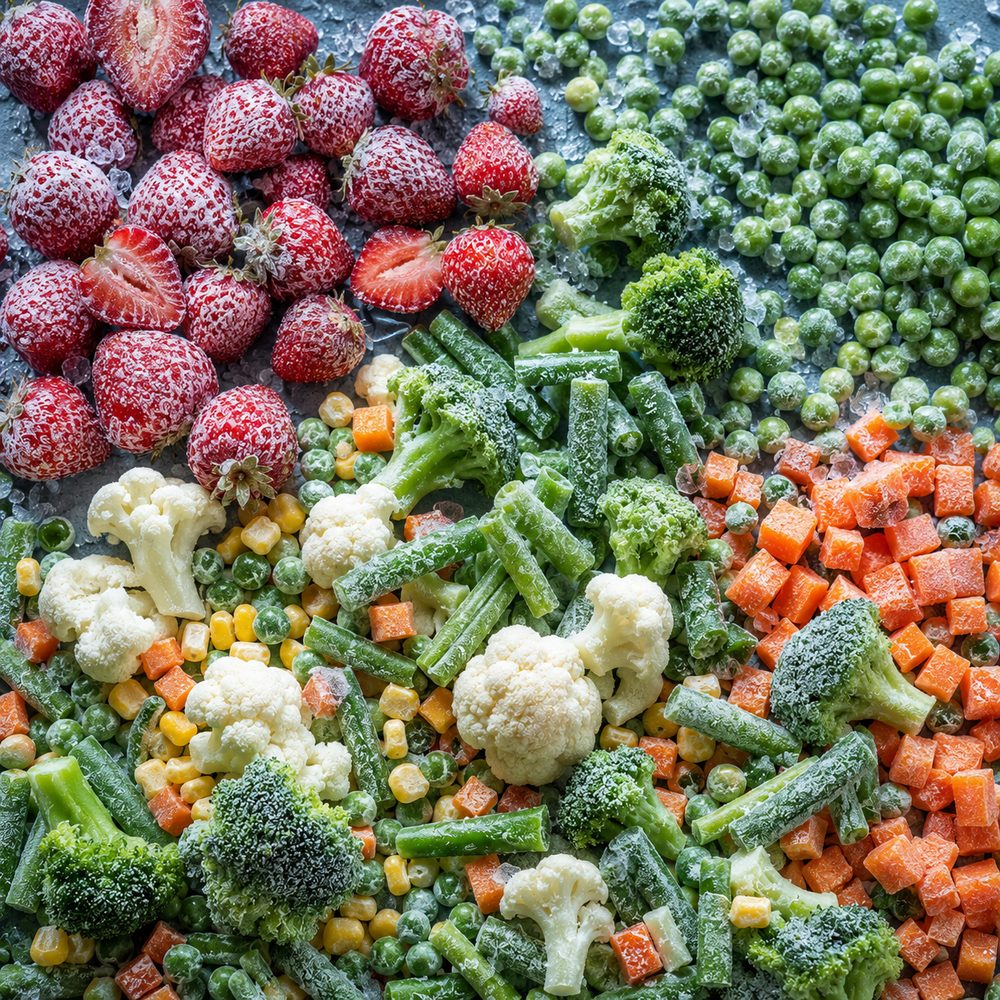
Frozen is the part of the Egyptian range that mid-size buyers most often assume is closed to them. The perception is that IQF only moves in full 40 ft loads on annual contracts, so a distributor needing four pallets of strawberry and two of okra does not bother asking. That is not how our frozen programme works. IQF is well suited to part-loads precisely because the product is stable, the pallet is uniform, and everything in the frozen range shares one set point.
What is available and in what grade
IQF strawberry is produced from Fortuna and Festival fruit during the winter harvest and offered as whole calibrated fruit at 15 to 25, 25 to 35 or 35 to 45 mm, as halves, or as dice at 10 mm. Grade A carries a maximum of 2 percent defective fruit and tight colour uniformity. Grade B is the standard choice for jam, bakery and smoothie manufacturers.
Okra is offered whole in three calibrations, under 3 cm for the premium Gulf trade, 3 to 5 cm as the volume grade, and 5 to 7 cm for food service, as well as cut at 1 to 2 cm rings. Molokhia is supplied as chopped leaf in frozen blocks or as IQF chopped, the block format being the one most Gulf and Levantine buyers recognise. Spinach, green beans, artichoke hearts, mixed vegetables and peas round out the range.
Bag formats and pallet configuration
The two working formats are the 10 kg bulk polybag inside a carton, and retail bags at 400 g, 800 g or 1 kg packed 10 or 20 to a carton. Bulk suits processors and repackers. Retail bags suit distributors selling into ethnic grocery and supermarket channels, and own-brand printing is available on a three to four week lead time at a minimum of one pallet per SKU.
| Format | Per carton | Per pallet |
|---|---|---|
| 10 kg bulk bag in carton | 10 kg | 90 to 100 cartons, 900 to 1000 kg |
| 400 g retail, 20 per carton | 8 kg | 110 to 120 cartons, 880 to 960 kg |
| 1 kg retail, 10 per carton | 10 kg | 90 to 100 cartons, 900 to 1000 kg |
A half pallet is the smallest sensible unit for a single SKU. Below that the handling cost per kilo stops making sense. A 40 ft frozen container takes 20 pallets, so a buyer taking six pallets is sharing with two or three other consignees on the same sailing.
Why frozen part-loads are easier than fresh
Every product in the IQF range runs at minus 18 degrees Celsius or colder. There is no set point negotiation, no ethylene sensitivity and no competing humidity requirement. Compare that with fresh, where combining products in one reefer means accepting a compromise temperature for at least one of them. Our note on set point conflicts in mixed fresh containers explains the constraint that frozen simply does not have. Shelf life is also on your side at 18 to 24 months from production, so a part-load does not create a sell-through problem the way a fresh mixed load can.
Timing your order against production
Strawberry is processed from December through March and drawn from cold store across the rest of the year, though the best grades and the sharpest pricing go to buyers who contract before the campaign. Okra runs from June to October, molokhia from May to September. Ordering strawberry in October means buying from the tail of last season’s store. Ordering in November for January production means buying from the new campaign. Both are legitimate, but they are not the same product and should not carry the same price.
Documents and loading
Shipments travel with a health certificate, certificate of origin, packing list with production and expiry dates per lot, and microbiological analysis. Loading is done from a cold store with the container pre-cooled, and a temperature logger inside the load is standard on our part-loads. For how the pallet arithmetic works out across a shared container, see our pallet maths guide for mixed containers.
To get a same-day quotation on an IQF part-load, request a specification sheet, or ask what is currently in store, message the Peivana desk on WhatsApp at +20 10 9911 1918. We are GLOBALG.A.P and BRC certified and can arrange third party inspection before loading.