
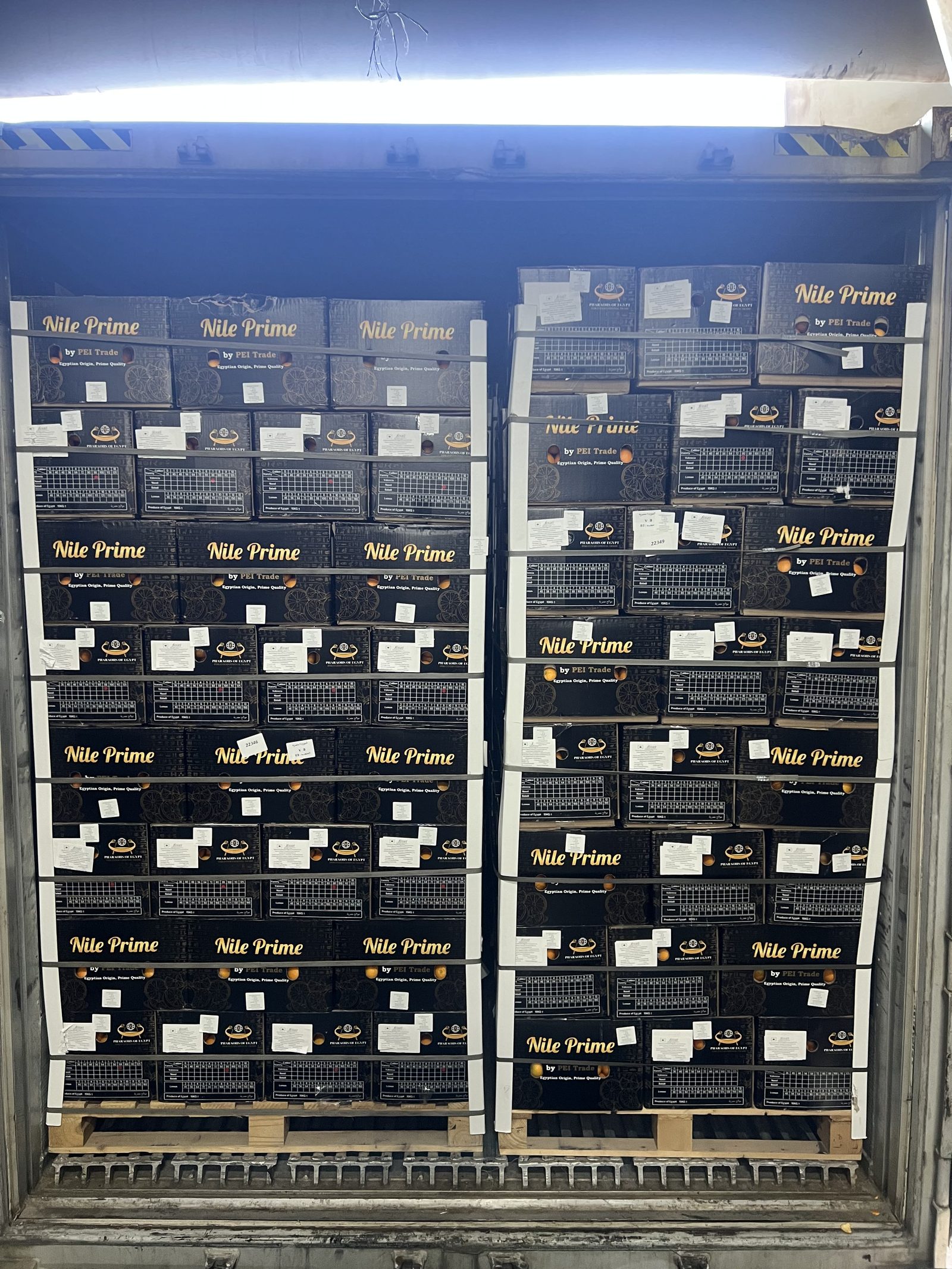
The first question a new buyer asks is almost always about price. The question that actually determines whether a deal happens is the minimum order quantity. Many Egyptian exporters quote one full 40 ft container as the floor and leave it there, which rules out a large share of serious buyers. Our position is different, and this note sets out the real numbers so buyers can plan against them instead of guessing.
Why minimums exist at all
A minimum is not a negotiating tactic. It reflects three real costs. The packhouse has to change over a line to run your specification, which takes time whether you order one pallet or twenty. The cold store has to stage and pick your lot separately. The forwarder charges a fixed handling fee per consignee on a shared container. Below a certain volume those fixed costs swamp the per-carton margin and the shipment stops being viable for either side. Understanding that makes the numbers below easier to work with.
Practical minimums by product
| Product | Working minimum | Notes |
|---|---|---|
| Fresh citrus | 2 pallets, about 1,600 kg | One count size per pallet |
| Fresh mango | 2 pallets, about 1,150 kg | Season dependent, June to October |
| Pomegranate | 2 pallets, about 1,600 kg | One variety and size per pallet |
| Onion and garlic | 4 pallets | Ambient, lower value per kilo |
| Potato and root vegetables | 4 pallets | Same reasoning as onion |
| IQF frozen | 1 pallet per SKU, half pallet on some lines | Long shelf life makes small lots workable |
| Dates | 500 kg | High value, stable, easy to consolidate |
| Dried herbs and spices | 300 to 500 kg | Low volume per kilo |
| Fresh herbs | 200 kg by air | Air freight, not sea |
Two points about the table. First, these are per SKU, not per order. Four pallets of one citrus count is straightforward. Four pallets split across eight counts is not, because each becomes a separate picking and labelling operation. Second, a low-value ambient product carries a higher minimum than a high-value one, which surprises buyers who expect the opposite. The fixed cost is the same either way, so it has to be recovered over more kilos when the margin per kilo is thin.
How a mixed container changes the arithmetic
The single most effective way to lower your effective minimum is to combine products in one reefer rather than order one product in a small quantity. A buyer taking two pallets of citrus, two of pomegranate, one of dates and one of dried herbs is above the minimum on every line and is filling six of twenty pallet positions. The remaining space is filled by other consignees, and the fixed cost per pallet falls for everyone. What limits the combination is not commercial but physical: the products in one reefer must tolerate a shared temperature. Dates and dried goods travel ambient, citrus and pomegranate share 5 to 8 degrees Celsius comfortably, and frozen has to go separately at minus 18.
Starting below the minimum
There is one exception worth knowing about. For a first-time buyer evaluating quality, we will send a sample carton or a single half pallet outside the normal minimum, priced to reflect the handling. That is an evaluation shipment rather than a commercial order, and it exists so a buyer can check the product before committing. Our guide to running a trial shipment from Egypt covers how to structure one so it actually tells you something useful.
Before you confirm
Whatever the volume, the quotation should state the count or calibration, carton format, cartons per pallet, pallet type, Incoterm under Incoterms 2020, named port and validity date. A quote missing any of those is not comparable with another quote. We break down what each line should tell you in our note on reading an Egyptian produce quotation.
If your requirement sits below what another exporter has told you is possible, it is worth asking us. Send your product list and target volume on WhatsApp to +20 10 9911 1918 and we will come back with a same-day quotation and a realistic loading plan. Peivana is GLOBALG.A.P and BRC certified.