
A wholesale mango order from Egypt starts realistically at one standard pallet, which is 200 cartons of 5 kg, or 1,000 kg net. A half pallet of 100 cartons and 500 kg still ships, but handling, re-stacking and documentation costs stop scaling down at that point, so the price per kilogram rises rather than falls.
Peivana is an Egyptian exporter, not a neutral marketplace or a review site. This page sets out the pack formats, count sizes, pallet configurations and container loads we work to, so a buyer can size an order before asking for a price. Most generic wholesale mango pages avoid the one question that decides whether a first order is worth placing: what the minimum actually is, and what going below it costs in handling.
Table of Contents
What Is the Minimum Wholesale Mango Order?
One standard pallet is the working minimum for wholesale mango: 200 cartons of 5 kg, 1,000 kg net. A half pallet of 100 cartons, 500 kg, is the smallest quantity that still travels as palletised freight rather than as loose cargo, and it is the level at which most first-time buyers start.
Below a half pallet the economics change shape. The fruit cost per kilogram is unchanged, but the fixed costs behind a shipment are not divisible: phytosanitary inspection, certificate of origin, customs entry, cold-store handling and the labour to build and shrink a part pallet are charged per consignment, not per kilo. Splitting a pallet also means the stack has to be re-built at the consolidation point, which adds a warm break the fruit would otherwise not see. That is the real cost of going small, and it is worth knowing before you ask for a quote on 200 kg.
Peivana works with small and mid-size buyers, so part loads, mixed containers, half pallets and trial orders are normal business rather than an exception. A trial half pallet alongside another product in a mixed container is usually the cheapest way to see the fruit before committing to a full reefer.
Wholesale Mango Pack Formats: 5 kg Carton and 5 kg Box
Egyptian mango exports in two 5 kg formats and one 4.5 kg format on request. The difference between the carton and the box is not the fruit but the packaging: the carton is the heavier corrugated build and palletises at 200 units, the box is lighter and palletises at 180. Same fruit, same counts, different landed packaging cost per kilogram.
| Pack format | Units per standard pallet | Net weight per pallet | Half pallet | Notes |
|---|---|---|---|---|
| 5 kg carton | 200 | 1,000 kg | 100 cartons / 500 kg | Default export format |
| 5 kg box | 180 | 900 kg | 90 boxes / 450 kg | Same fruit, lower packaging cost, fewer units per pallet |
| 4.5 kg carton | 200 | 900 kg | 100 cartons / 450 kg | Available on request |
Counts Per 5 kg Carton: 6 to 16 Pieces
Count is the number of fruit in a 5 kg carton, and it fixes the average piece weight. Egyptian wholesale mango is packed to counts 6, 7, 8, 9, 10, 12, 14 and 16. Counts 11, 18 and 20 are not packed, and count 16 is the smallest size that goes into an export carton. Sizing and marketing quality conventions for fresh produce in international trade are published in the UNECE standards for fresh fruit and vegetables.
| Count per 5 kg carton | Fruit weight per piece | Pieces per pallet (200 cartons) |
|---|---|---|
| 6 | 775 to 900 g | 1,200 |
| 7 | 670 to 775 g | 1,400 |
| 8 | 590 to 670 g | 1,600 |
| 9 | 530 to 590 g | 1,800 |
| 10 | 460 to 530 g | 2,000 |
| 12 | 385 to 460 g | 2,400 |
| 14 | 335 to 385 g | 2,800 |
| 16 | 295 to 335 g | 3,200 |
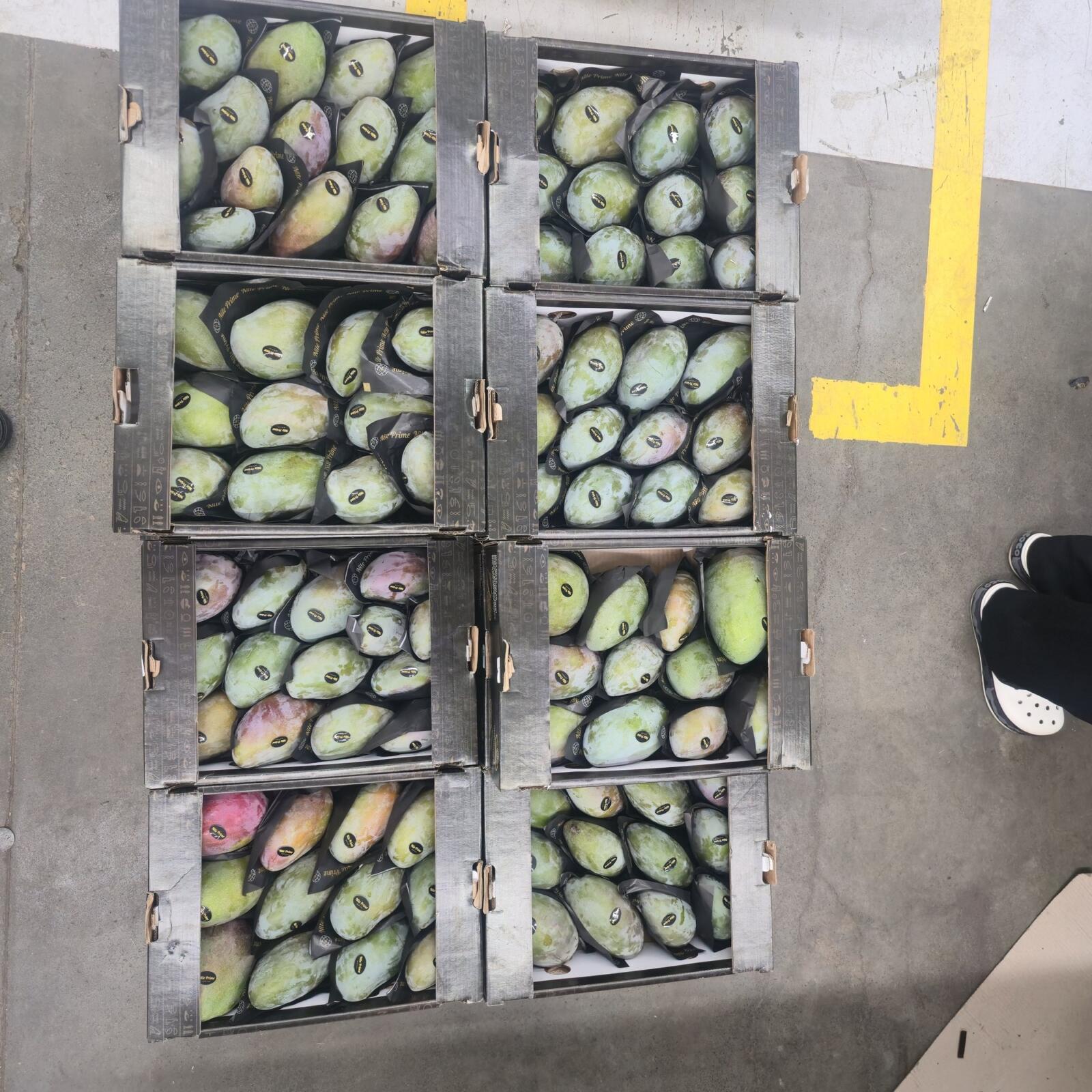
Which count to buy is a market question rather than a quality question. Counts 6 to 8 sell into gift packs, hotel supply and premium retail where piece size carries the price. Counts 10 to 14 are the volume sizes for supermarket punnets and wholesale market trade. Count 16 goes mainly to processing and to markets that price per piece rather than per kilogram.
Container Loading: 4,160 Cartons in a 40 ft Reefer
A 40 ft reefer takes 20 standard pallets plus one euro pallet, which is 4,160 cartons of 5 kg, or 20,800 kg net. In the 5 kg box format the same container carries 3,744 boxes and 18,720 kg net. A 20 ft reefer takes 10 standard pallets, 2,000 cartons and 10,000 kg net.
| Container and format | Pallets | Units | Net weight |
|---|---|---|---|
| 40 ft reefer, 5 kg carton | 20 standard + 1 euro | 4,160 cartons | 20,800 kg |
| 40 ft reefer, 5 kg box | 20 standard + 1 euro | 3,744 boxes | 18,720 kg |
| 20 ft reefer, 5 kg carton | 10 standard | 2,000 cartons | 10,000 kg |
Use those figures as an arithmetic check on any offer. A supplier quoting 24 tonnes of mango in a 40 ft reefer is either counting gross weight as net or has not built the stack the way mango is stacked, and a supplier quoting 15 tonnes is leaving a fifth of the container empty and charging you for it.
Egyptian Mango Varieties and Brix, Owaisi to Keitt
Egyptian export varieties split into a high-Brix local group and a lower-Brix international group. Owaisi at 18 to 22 degrees Brix sits at the sweet end; Keitt, Naomi and Tommy Atkins at 12 to 15 degrees are firmer, travel longer and hold shelf life better. Brix is measured on the fruit at packing and varies with harvest week and orchard.
| Variety | Brix range | Group |
|---|---|---|
| Owaisi | 18 to 22 degrees | Egyptian local |
| Sedeeka | 17 to 20 degrees | Egyptian local |
| Zebda | 16 to 20 degrees | Egyptian local |
| Timour | 16 to 19 degrees | Egyptian local |
| Fagri Kelan | 15 to 18 degrees | Egyptian local |
| Kent | 14 to 16 degrees | International |
| Shelly | 14 to 16 degrees | International |
| Keitt | 13 to 15 degrees | International |
| Naomi | 13 to 15 degrees | International |
| Tommy Atkins | 12 to 14 degrees | International |
Two names come up in enquiries and are worth settling. Alphonso is an Indian variety and Ataulfo is Mexican. Neither is grown commercially in Egypt, and an Egyptian offer using either name is mislabelled. If a buyer wants Alphonso-style sweetness from an Egyptian origin, Owaisi and Sedeeka are the closest comparison on Brix, though the flesh texture and fibre profile are not the same fruit.
Why Wholesale Mango Cannot Share a Container With Citrus
Mango carries at 10 to 12 degrees Celsius and is chilling-sensitive, which rules out sharing a reefer with citrus at 4 to 6 degrees or table grapes at 0 to 1 degree. There is one thermostat per container. Set it for the citrus and the mango arrives with chilling injury: pitted skin, grey flesh under the surface and fruit that never ripens properly.
This is the constraint that decides what a mixed container can actually contain. Mango consolidates with other products that hold in the same 10 to 12 degree band, not with the citrus programme a buyer may already be running. If you want both in the same season on a small volume, they travel as two consignments, and the freight arithmetic has to be done that way from the start.
Count Tolerance and Contract Terms
Peivana’s contract standard for count tolerance on wholesale mango is 5 to 10 per cent of the adjacent count by piece, and it belongs in the written contract rather than in an email. A carton nominally packed to count 10 may therefore carry a small proportion of count 9 or count 12 fruit within the agreed percentage. Fixing that number in advance removes the most common source of arrival disputes.
Three other clauses are worth writing down before the first order: the carriage temperature and the tolerance band on it, the Brix figure measured at packing and the method used, and who bears the cost if inspection at origin delays a booked sailing. Mango is perishable and no exporter can guarantee an arrival condition; what an exporter can do is state the packing specification, the carriage regime and the evidence trail, and stand behind those.
Most first orders go wrong on count tolerance, not on fruit quality. Write the percentage into the contract and half the arguments disappear.
Mohamed Barakat, Export Manager, Peivana
Wholesale Mango: Common Buyer Questions
What is the minimum wholesale mango order from Egypt?
One standard pallet, which is 200 cartons of 5 kg or 1,000 kg net. A half pallet of 100 cartons and 500 kg is the practical floor. Below a half pallet the fixed costs per consignment, inspection, certificates, customs entry and cold-store handling, no longer scale down, so the cost per kilogram rises.
How many mango cartons fit in a 40 ft reefer container?
A 40 ft reefer takes 20 standard pallets plus one euro pallet: 4,160 cartons of 5 kg, or 20,800 kg net. In the 5 kg box format the same container carries 3,744 boxes and 18,720 kg net. A loaded 40 ft mango reefer lands between 18.7 and 20.8 tonnes net against a maximum payload of 25 tonnes.
What count sizes are available in a 5 kg mango carton?
Counts 6, 7, 8, 9, 10, 12, 14 and 16. Count 6 is 775 to 900 g per fruit and count 16 is 295 to 335 g. Counts 11, 18 and 20 are not packed, and count 16 is the smallest size that goes into an export carton.
What is the difference between a 5 kg mango carton and a 5 kg box?
The fruit and the counts are identical. The carton is the heavier corrugated build and palletises at 200 units for 1,000 kg net per pallet. The box is lighter and palletises at 180 units for 900 kg net. The box lowers packaging cost per kilogram but puts less weight on each pallet.
Can mango ship in the same container as oranges?
No. Mango carries at 10 to 12 degrees Celsius and is chilling-sensitive, while citrus carries at 4 to 6 degrees and table grapes at 0 to 1 degree. A reefer has one thermostat, so setting it for citrus causes chilling injury in the mango. Mango consolidates only with products that hold in the same 10 to 12 degree band.
Which Egyptian mango variety is sweetest?
Owaisi, at 18 to 22 degrees Brix, is the highest of the Egyptian export varieties, followed by Sedeeka at 17 to 20 and Zebda at 16 to 20. Keitt, Naomi and Tommy Atkins sit lower at 12 to 15 degrees but are firmer and travel longer. Alphonso and Ataulfo are Indian and Mexican varieties and are not grown in Egypt.
Getting a Wholesale Mango Quote
To price a wholesale mango order, Peivana needs four things: variety, count, pack format and quantity in pallets. Give us those and a destination port and we normally come back the same working day. If you are testing the fruit for the first time, ask about a half pallet in a mixed container rather than a full reefer.
Written by the Peivana export desk. Peivana is an Egyptian fresh produce exporter. Last updated 26 August 2026.