
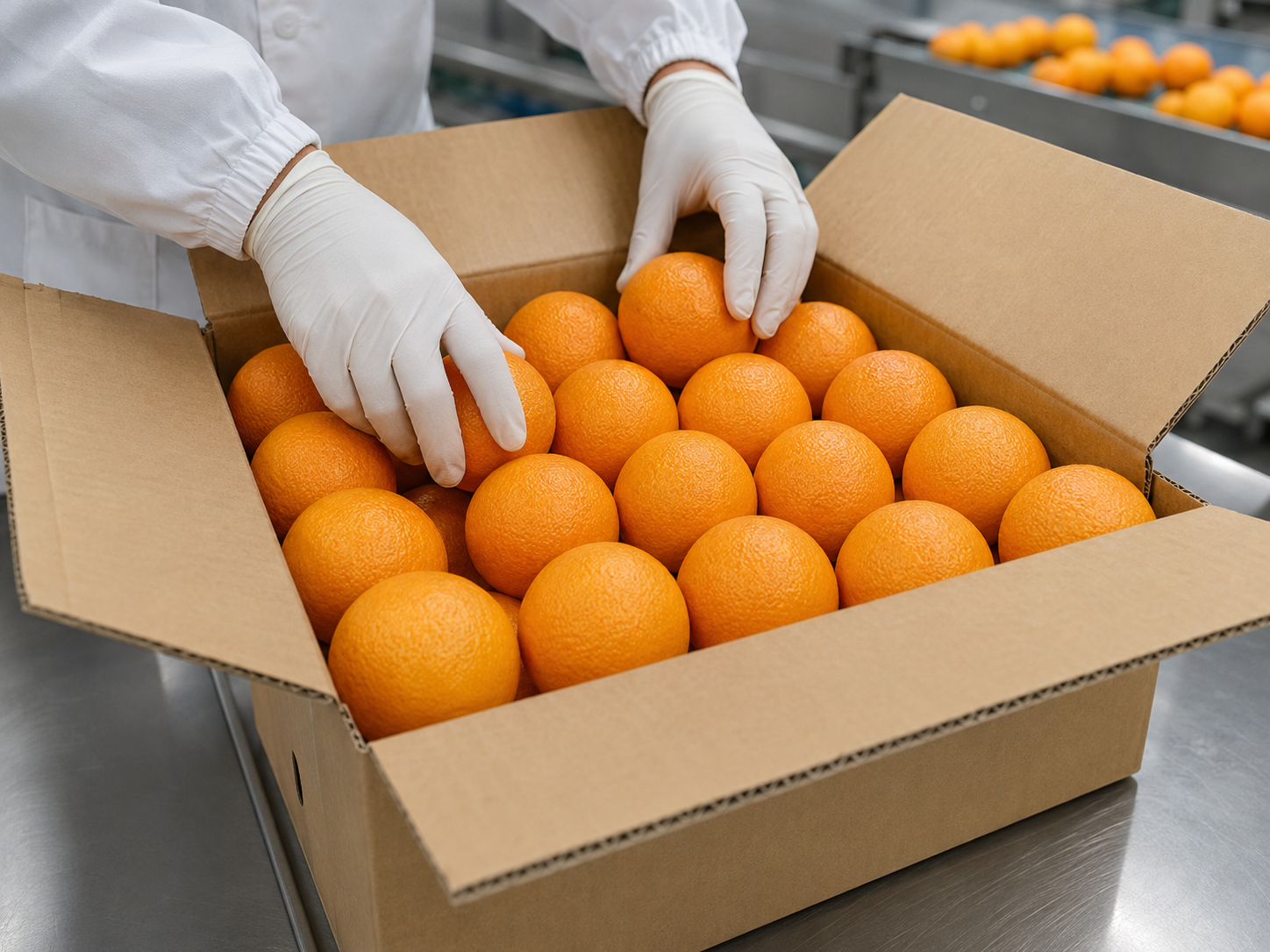
Rejections at destination are more often a labelling problem than a quality problem. The fruit is fine, the paperwork is fine, and the cartons carry the wrong information or not enough of it. On mixed and part-load shipments the risk is higher, because one container can carry four products going to three different regulatory regimes. This is what needs to be printed, and where the rules differ.
What every export carton needs
Regardless of destination, a fresh produce carton leaving Egypt should carry the name and address of the packer or dispatcher, the country of origin stated as Egypt or Product of Egypt, the product name and variety, the class, the size or count, the net weight, and a lot or batch code that ties back to the packhouse record for that day. The lot code is the one that gets skipped most often and matters most, because it is what makes a traceability request answerable in an afternoon rather than a week.
European Union and United Kingdom
EU marketing standards require the packer and dispatcher identification, origin, class and size on each package, in a language the destination market understands and in characters grouped on the same side of the carton. For products covered by specific marketing standards, including citrus, apples, kiwifruit, peaches, strawberries, table grapes, tomatoes, peppers and lettuce, the full standard applies. Other produce falls under the general marketing standard, which is lighter but still requires origin.
Traceability under the EU general food law means you must be able to identify the immediate supplier and the immediate customer for every lot, one step back and one step forward. A GS1-128 pallet label with an SSCC serial number is not legally required, but most EU distributors now expect it and some retail chains will refuse a delivery without one. The UK applies retained equivalents of these rules. The practical difference is that UK retail customers tend to ask for their own supplier code printed alongside yours.
Gulf Cooperation Council markets
GCC requirements are stricter on language and dating. Labels for prepacked items must carry Arabic text, either as the primary language or alongside English. Production date and expiry or best before date are expected on packaged and prepacked lines, which surprises exporters used to shipping loose fruit into Europe where a date is not required. Country of origin must be clear and unambiguous. For loose bulk cartons, English marking with origin is generally accepted, but retail-facing packs need Arabic. If your Gulf customer is a supermarket rather than a wholesaler, ask for their label artwork before you print anything.
The mixed container problem
On a mixed load, marking is per carton, not per pallet. A pallet holding three products needs each carton marked with its own product, class, size and lot code, and the pallet label should list the products and quantities it carries. A single generic pallet label describing the whole pallet as assorted vegetables is what triggers an inspection hold. Our guide to one shipment, several products, one clean file covers how the paperwork should mirror the carton marking.
Wooden pallets need the ISPM 15 heat treatment stamp, visible on at least two opposite sides. Plastic and pressed pallets do not require it, which is one reason some buyers specify them.
Own-brand and private label
Printing your own brand on the carton does not remove the packer and origin requirements. Your brand can be the dominant graphic, but the regulatory block still has to be there, either printed or applied as a compliant label at packing. Minimum print runs and lead times are covered in our note on private label packing for mid-size distributors.
Peivana packs to buyer artwork or plain cartons with compliant marking for EU, UK and GCC destinations, backed by GLOBALG.A.P and BRC certified sourcing. Send us your destination market and channel and we will confirm the label block before printing. WhatsApp +20 10 9911 1918.