
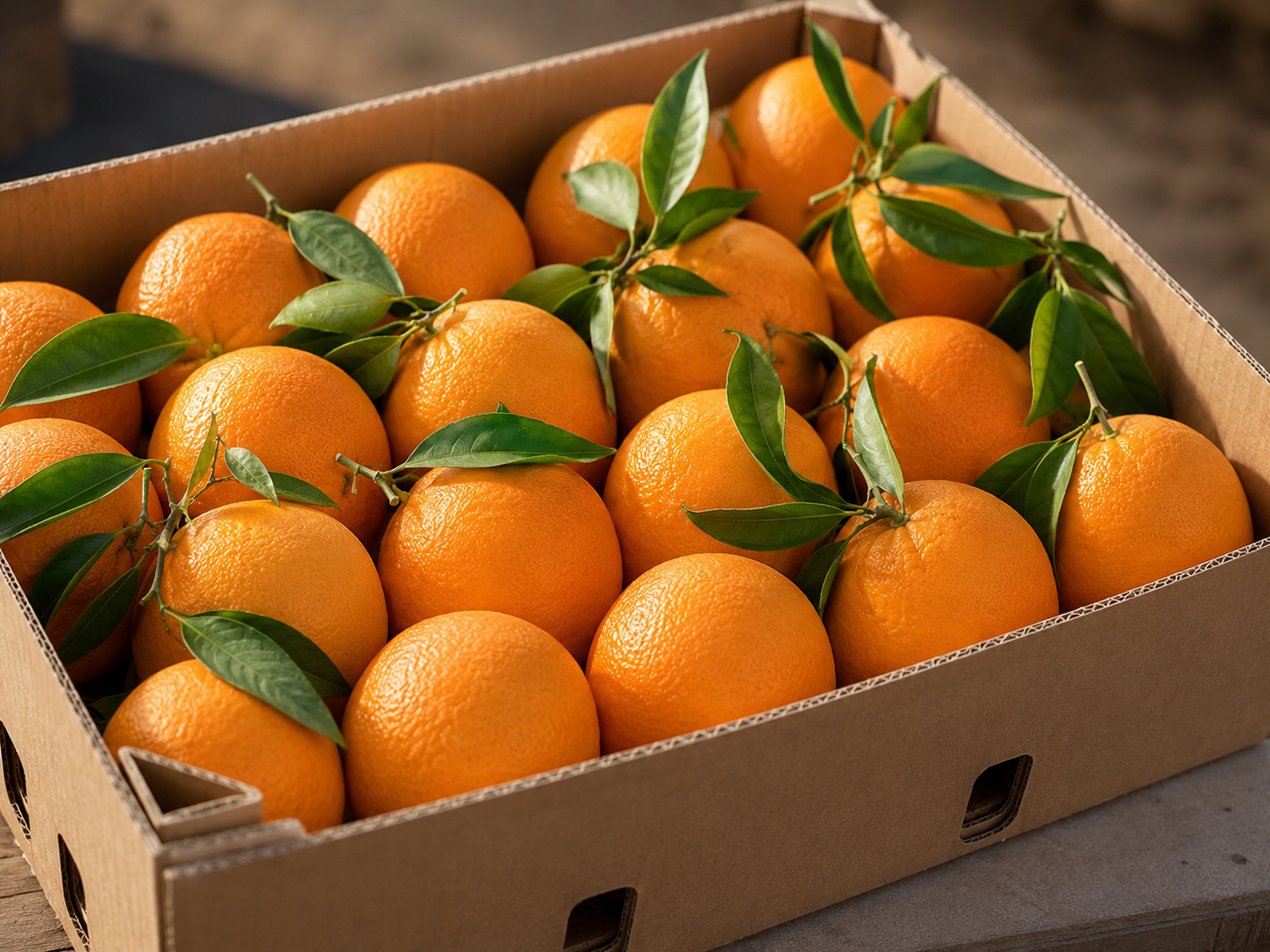
The Egyptian citrus season opens in December and runs to May, and it is the point in the year when a mid-size buyer feels the volume problem most sharply. A single variety in a full reefer is 24 to 26 tonnes of one fruit landing in one week. For a distributor turning over two or three pallets of oranges a week, that is a month of stock and a guaranteed quality decline in the back half. Splitting citrus across a mixed container solves it, and December to May is when the mixed load actually gets easier, because oranges and mandarins overlap in a narrow 5 to 6 C band.
Season windows by variety
Navel opens first, from mid December through February, and it is the eating orange. Good colour, seedless, easy to sell at retail, but it does not hold as long as Valencia and it should be moved within three to four weeks of arrival.
Valencia follows from February through May and is the workhorse. Higher juice content, thinner skin, better shelf life, and the variety most juice and food service buyers specify. Late Valencia into May can carry regreening on the skin, which is cosmetic and does not affect internal quality, though retail buyers should be told in advance.
Mandarins run December to March, mainly Murcott and clementine types. They are the most delicate of the three and the least tolerant of rough handling in a mixed stow, so they should be placed where they will not be crushed by heavier pallets.
Sizes and carton formats
Egyptian oranges are graded by count per 15 kg carton. Counts 48, 56, 64, 72, 80, 88 and 100 are all available, with 56 to 72 the mainstream export range and the easiest to source in small quantities. The larger counts, 48 and below, are usually committed to full-container programmes early and are harder to get in a part-load.
Standard packing is a 15 kg telescopic carton, either open top or with a lid, 40 or 42 cartons to a pallet layer configuration that gives roughly 1,000 kg per Euro pallet. Mesh bags of 5 kg or 10 kg inside a master carton are common for wholesale markets and reduce cost per kilo. Mandarins pack in 10 kg or 5 kg cartons, often with individual net sleeves on premium grades.
A half pallet of oranges is approximately 500 kg, or 33 cartons at 15 kg. That is a realistic minimum for one variety inside a mixed load, and it is enough to test a market without committing the season.
What citrus can share a container with
Citrus carries at 5 to 7 C for oranges and 4 to 6 C for mandarins, with 90 to 95 percent humidity and vents open. That pairs cleanly with pomegranate, green beans, sugar snaps and most winter vegetables. It does not pair with onion, which needs low humidity and heavy ventilation, or with dates and sweet potato, which run warmer. Our note on which Egyptian products can share one temperature sets out the compatible groups. For working out how much of each product fits, see pallet maths for mixed containers.
Booking ahead of December
Citrus packhouses fill their programme slots between September and November. A buyer approaching an Egyptian exporter in January for February Valencia will be quoted spot, and spot in a tight year is 15 to 25 percent above programme pricing. Indicating volume by variety and month before the season opens costs nothing and protects the price.
Peivana builds mixed containers to order and quotes the same day. GLOBALG.A.P and BRC certified sourcing, own-brand carton printing available, and part-loads from half a pallet. To reserve citrus volume for the 2026/2027 season, message us on WhatsApp at +20 10 9911 1918.