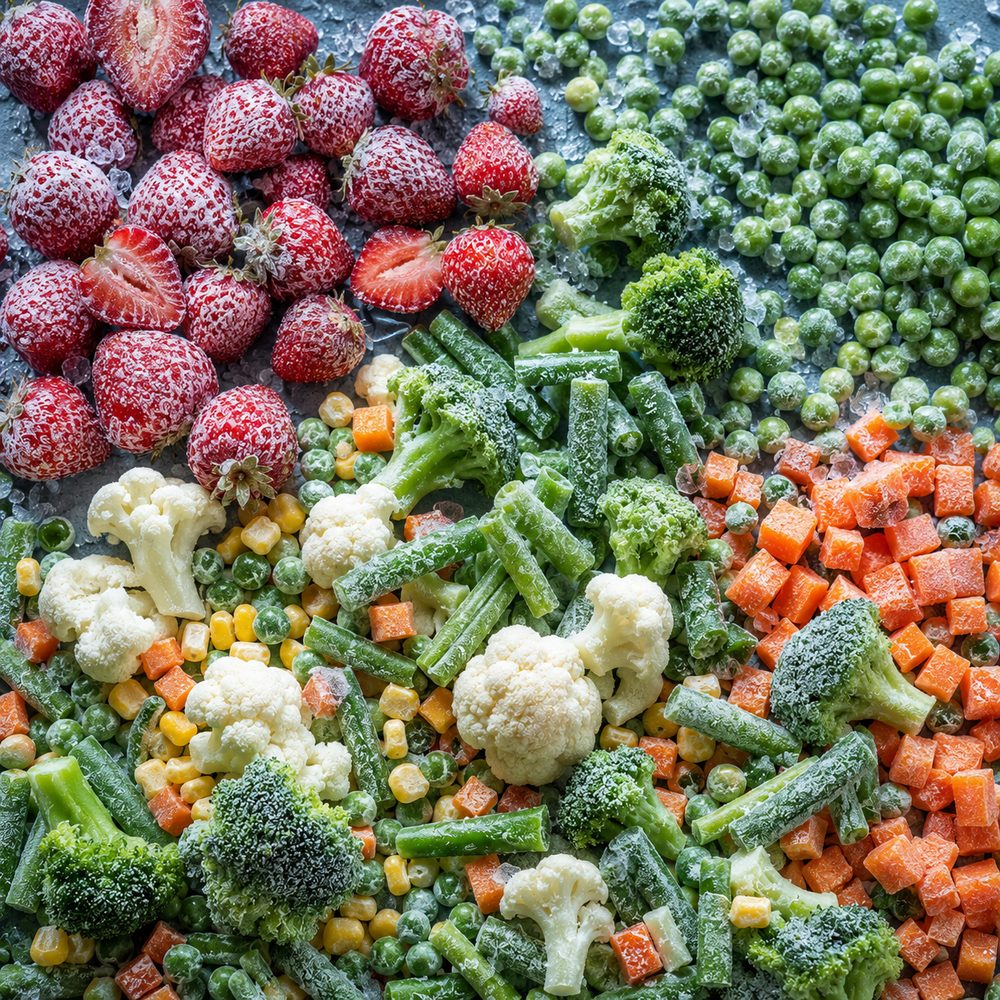
Frozen products are easier to mix than fresh ones. Everything in the load travels at the same temperature, nothing ripens, nothing gives off ethylene and shelf life is measured in months rather than days. That makes a mixed IQF container the most practical way for a mid-size distributor to carry a full Egyptian frozen range without tying up cash in four separate full loads.
What fits in one container
A 40ft high cube reefer running at minus 18 degrees Celsius or colder takes 20 pallets at 120 by 100 cm and carries roughly 24 to 26 tonnes of frozen product depending on carton weight and stack height. The fresh air vent stays fully closed for the whole voyage. That pallet count is the planning unit. Rather than thinking in tonnes, think in pallets, because the packhouse builds the load pallet by pallet and each SKU occupies whole pallets.
Our working minimum is one pallet per SKU, which normally lands between 800 and 1000 kilogrammes depending on the pack. A typical first mixed load might run eight pallets of IQF strawberry, four of zero grade okra, four of chopped molokhia and four of artichoke hearts. A buyer wanting broader range can go to eight or ten SKUs at one pallet each, though the loading cost per SKU rises as the pallets get thinner.
Specification by product
IQF strawberry is available as whole Class 1 and Class 2, calibrated in 15 to 25 mm and 25 to 35 mm bands, and as sliced, diced or crumble for industrial use. The variety and the intended use should be stated in the order, since a yoghurt plant and a retail bag buyer want very different fruit. Full detail sits in our note on Egyptian IQF strawberry exports.
Okra is sorted by pod length, with zero grade under 4 cm commanding the premium, grade one at 4 to 6 cm as the volume line, and sliced okra for foodservice. Molokhia ships chopped, either in 400 gramme retail bags or in bulk cartons for catering. Artichoke moves as hearts, bottoms or quarters. Green beans, spinach, mixed vegetables and pepper strips can all sit in the same load. Buyers building a custom mix should read our guide to IQF mixed vegetable specifications before fixing the recipe.
Packing and labelling in a mixed load
The most common source of trouble on a mixed container is labelling rather than product. Each SKU needs its own carton artwork, its own batch coding and its own line on the packing list, and where the destination requires country of origin, net weight and nutrition declarations in the local language, that has to be settled before printing rather than at the port. Retail bags of 400 grammes, 1 kilogramme and 2.5 kilogrammes in outer cartons, and bulk formats of 10 kilogrammes, cover most requirements.
Documentation is issued as a single set for the container, with the health certificate, certificate of origin and packing list itemising every SKU. Peivana facilities are GLOBALG.A.P and BRC certified, and third-party inspection can be arranged on request.
Getting a price on a mix
Send the SKU list with the quantity per SKU, the pack format and the destination port, and we return a quotation on the same working day. If you are still deciding on the mix, send an indicative list and we will come back with the pallet allocation that fills a container cleanly rather than leaving a half pallet of freight paid for and unused.
Message the Peivana desk on WhatsApp at +20 10 9911 1918 with your SKU list and destination port.