
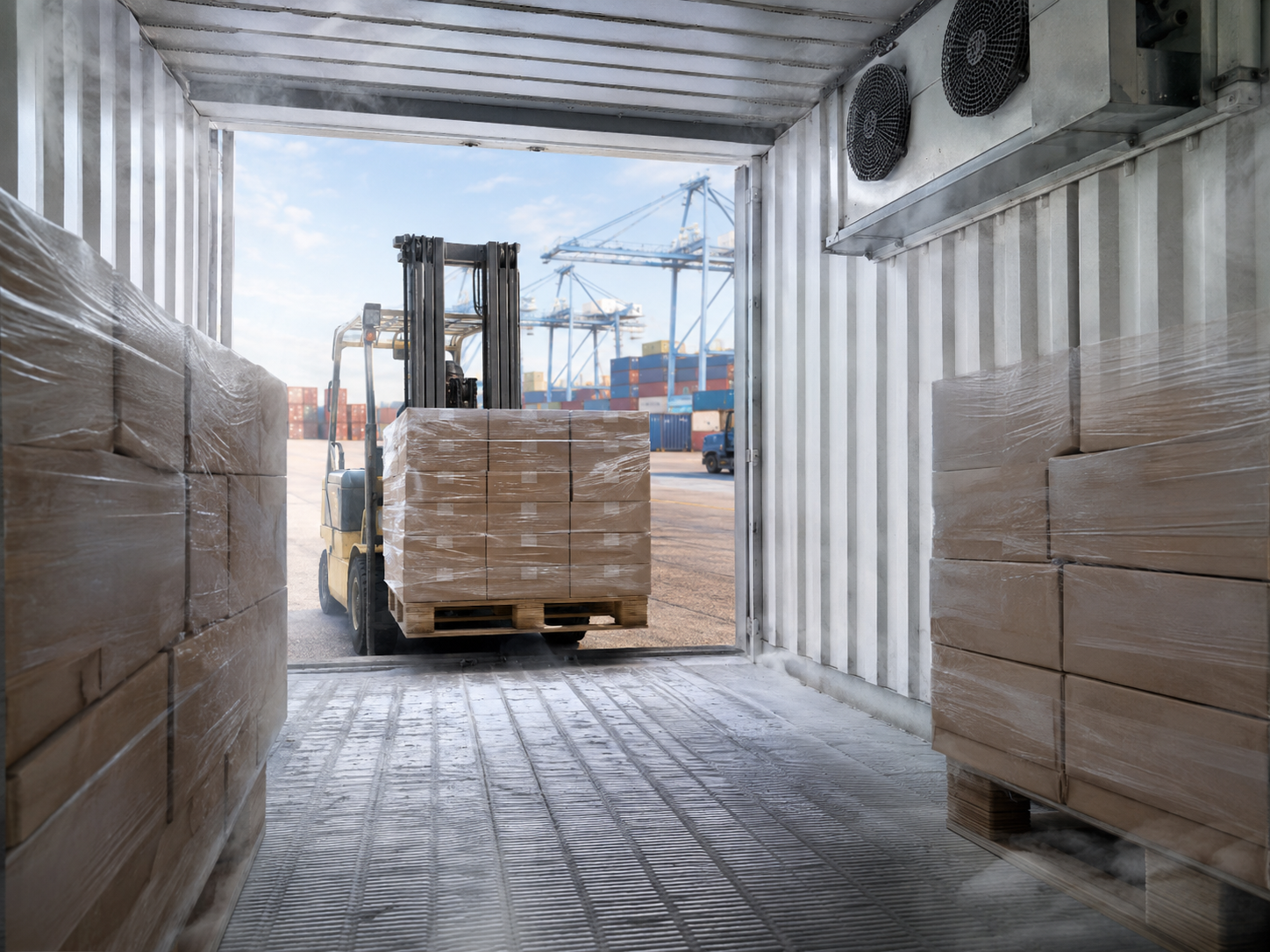
Most mixed-container conversations start with a product list and end with a surprise. The buyer wants five items, the exporter comes back with three, and nobody explained why. The answer is almost always one of two constraints: pallet positions or payload weight. Both are simple to work out in advance, and doing so turns a vague enquiry into a load plan.
Start with pallet positions, not cartons
A 40ft high cube reefer gives you 20 to 21 Euro pallet positions of 120 by 80 cm, or 10 to 11 positions on 120 by 100 cm industrial pallets loaded in a single row. That number is the true unit of a mixed container. You are not buying tonnes, you are buying pallet slots.
Usable stack height is lower than people expect. The return air duct and the T-bar floor mean you generally work with about 2.2 metres of loadable height, and the load must never block the ceiling airflow channel. A pallet stacked to the roof will starve the rear of the container of cold air.
So the first question is not how many kilos you want. It is how many of the 20 slots each product should take.
Weight limited or volume limited
Every product falls into one of two categories, and this decides how a mix behaves.
Dense products hit the weight ceiling first. A 40ft reefer typically allows around 25 to 27 tonnes of payload depending on the line and the destination road limits. Onions in 25 kg mesh bags, potatoes, citrus in 15 kg cartons and IQF in 10 kg cartons all reach that ceiling before the container is visually full. Light products hit the volume ceiling first. Fresh herbs, leafy items, punnetted fruit and lightly packed cartons fill the slots long before the weight matters.
A well-built mixed load pairs one dense product with one light one. Filling twenty slots with dense product means paying for a container you cannot legally load.
Indicative counts per full container
These are working figures for planning, not contractual numbers, and they shift with pallet type and carton dimensions.
Oranges in 15 kg telescopic cartons run roughly 1,540 to 1,600 cartons per 40ft high cube, around 23 to 24 tonnes. Mango in 4 kg ventilated cartons runs roughly 4,400 to 4,800 cartons, around 18 to 19 tonnes, volume limited rather than weight limited. IQF product in 10 kg cartons runs roughly 2,000 to 2,200 cartons and reaches the weight limit. Onions in 25 kg mesh bags run roughly 1,000 to 1,080 bags and are firmly weight limited. Pomegranates in 4.5 kg cartons run roughly 4,000 to 4,400 cartons.
Divide by twenty to get the per-slot figure, then build your mix. Five pallets of mango and fifteen of pomegranate is a coherent load. Ten pallets of onion and ten of citrus is not, because the weight arrives long before the space does.
The temperature rule nobody can bend
A reefer runs one set point. That is the hard limit on what can share a container, and no amount of commercial goodwill changes it.
Frozen product runs at minus 18 degrees Celsius and can only travel with other frozen product, which is why an IQF mix is built separately, as set out in our guide to building a mixed IQF container from Egypt. On the chilled side, citrus sits at 3 to 5 degrees, pomegranate at 5 to 7, grapes at 0 to 1, and mango at 10 to 12. Mango and citrus in the same box means one of them is being handled wrong. Compatible chilled groupings are covered in our note on building a late-summer mixed fruit container.
Ethylene and odour
Beyond temperature, two products can share a set point and still be a bad match. Onion and garlic transfer odour into fruit. Ethylene producers such as mango accelerate ripening in sensitive items loaded alongside them. Where set points are compatible but the products are not, the answer is two containers or a different pairing.
Give us four numbers
To get a load plan rather than a rough answer, send the products you want, the approximate share of the container for each, the destination port and your target arrival week. We will confirm what fits, what has to move to a second container and what the resulting pallet split looks like. Message our team on WhatsApp at +20 10 9911 1918 and we will come back the same working day.