Onions and garlic are the two products mid-size buyers most often want in smaller quantities and most often get quoted only by the full container. They are heavy, they are cheap per kilo, and the freight per carton looks unattractive on a small volume. That is exactly why they work well as the ballast component of a mixed load rather than as a standalone shipment, and why the bag format you choose matters more here than on almost any other product.
What is available and when
Egyptian onions fall into two commercial groups. Golden or yellow onions from the main crop are lifted from March through June and store into the autumn, with the Giza and Behairy types the usual export selections. Red onions run alongside them with a shorter storage life and a narrower export window. There is also an early crop from December to February aimed at buyers who need volume before other origins open.
Garlic follows a tighter cycle. Egyptian white and pink garlic is harvested from March into May, cured for two to four weeks, and shipped from May onward, with cold-stored material available across the rest of the year. Dry-curing quality is what determines whether a lot travels well, so ask when the crop was lifted rather than only when it will be loaded.
Bag formats and pallet quantities
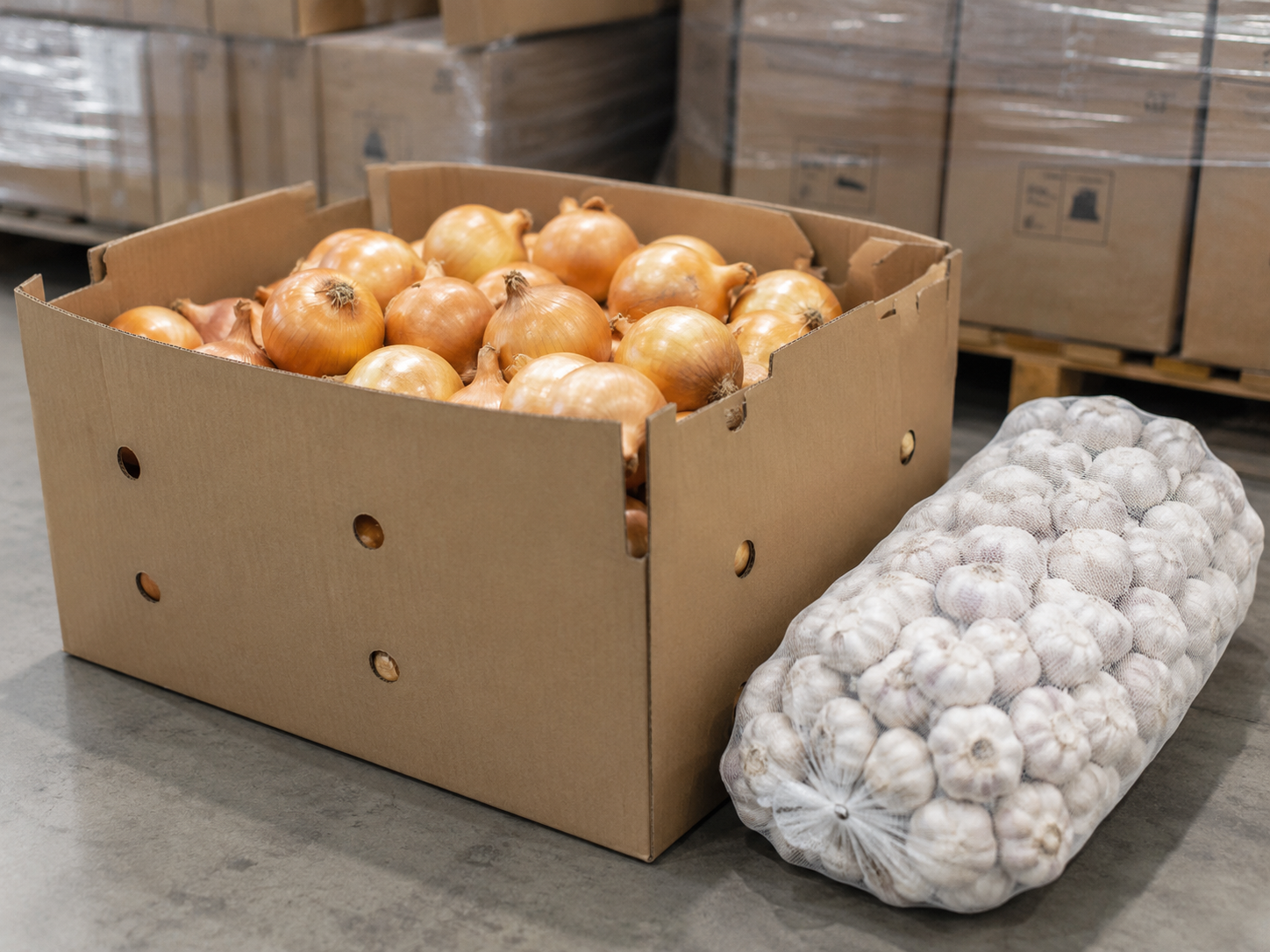
Onions ship in mesh bags of 5, 10, 20 or 25 kg, in ventilated cartons of 10 or 15 kg for retail-facing buyers, or in big bags of 500 to 1,000 kg for processors and wholesalers. A standard export pallet of 25 kg mesh bags carries 40 bags at 1,000 kg gross, which makes the arithmetic easy on a part-load. A half pallet of 500 kg is a realistic minimum for a mixed container and is enough for a distributor to test a grade without committing to volume.
Garlic is normally supplied in 10 kg cartons, either loose bulbs or pre-packed in 250 g to 1 kg consumer nets, or in 5 and 10 kg mesh bags. A pallet of 10 kg cartons runs 80 to 100 cartons depending on stacking height, so 800 to 1,000 kg per full pallet and 400 to 500 kg on a half. Consumer-pack garlic costs more per kilo but arrives ready for shelf, which is often the better economics for a mid-size retailer.
Sizing is quoted by diameter. Onions are traded at 40 to 60 mm, 50 to 70 mm, 60 to 80 mm and 70 mm plus, with 50 to 70 mm the general-purpose grade. Garlic is quoted at 4.5 cm, 5.0 cm, 5.5 cm and 6.0 cm bulb diameter, with 5.5 cm the common export size. Specify the range in the order rather than accepting a single nominal figure.
How they behave in a mixed container
Both products want a dry, ventilated environment and neither belongs next to anything that respires heavily or releases moisture. Onions and garlic hold well at 0 to 2 degrees Celsius at 65 to 70 percent relative humidity, which is a lower humidity than most fresh produce wants. They also carry a strong odour that transfers into other cargo, so they should not travel alongside dairy, eggs, or products with an open surface. Our note on reefer set point conflicts in mixed containers sets out which combinations work and which do not.
Weight is the other constraint. A 40ft reefer reaches its payload limit well before it fills on onions, so onions are usually the floor of a mixed load with lighter products stacked above and around them. The pallet maths guide covers how to balance the two.
Ordering and cost
Because the product value per kilo is low, freight is a much larger share of the landed cost than on fruit. That makes the ordering decision sensitive to how full the container is rather than to the unit price, and it is worth running the numbers before negotiating the price per tonne. The method is set out in our guide to building landed cost on an Egyptian part-load.
Minimum quantities on both products are one half pallet within a mixed container, or one full pallet as a standalone line on a groupage booking. Peivana is GLOBALG.A.P and BRC certified, and lot-level phytosanitary and residue documentation is issued with every shipment.
For a same-day quotation on onion or garlic part-loads, or to add either product to a mixed container you are already building, message the Peivana team on WhatsApp at +20 10 9911 1918.