Buyers in Tbilisi, Baku, Almaty and Tashkent ask us the same first question: can Egyptian produce actually reach us in reasonable condition, and can we start with less than a full container. The answer to both is yes, but the routing decisions matter more here than on any short Mediterranean lane, and the product list that survives the journey is narrower.
How cargo actually gets there
There is no direct sea route to a landlocked destination, so every option is multimodal. Three patterns dominate.
The Black Sea route runs from Alexandria or Damietta to Poti or Batumi in Georgia, then onward by road or rail. For Georgian buyers this is the shortest and simplest option. For Azerbaijan it continues overland to Baku. For Central Asia it can continue across the Caspian, though that leg adds handling and schedule uncertainty.
The Turkish land bridge routes to Mersin or another Turkish port, then overland east. This suits smaller consignments and can be quicker than waiting for a Black Sea sailing, but involves an additional transhipment and customs transit.
The northern route via Novorossiysk into the Russian rail network serves Kazakhstan and Uzbekistan, and is the established path for volume. Availability, banking and insurance on this lane change from season to season, so confirm current practice with your forwarder rather than assuming last year’s arrangement still applies.
Total transit on any of these is long. Sea leg to a Black Sea port typically runs eight to fourteen days from Egyptian loading, and the overland or rail continuation can add anywhere from three days for Georgia to two weeks or more for a deep Central Asian destination. Plan on four to six weeks from order confirmation to warehouse for Kazakhstan and Uzbekistan.
Products that suit the distance
Long multimodal transits rule out the short-shelf-life fruit that European buyers take from Egypt. Guava, figs, fresh herbs and ripe mango are not realistic on these lanes. What does travel well falls into three groups.
Storage vegetables are the backbone. Onions and garlic in mesh or raffia bags tolerate long journeys and are the single largest Egyptian line into Central Asia. Formats and half-pallet quantities are covered in our note on Egyptian onion and garlic in part-loads.
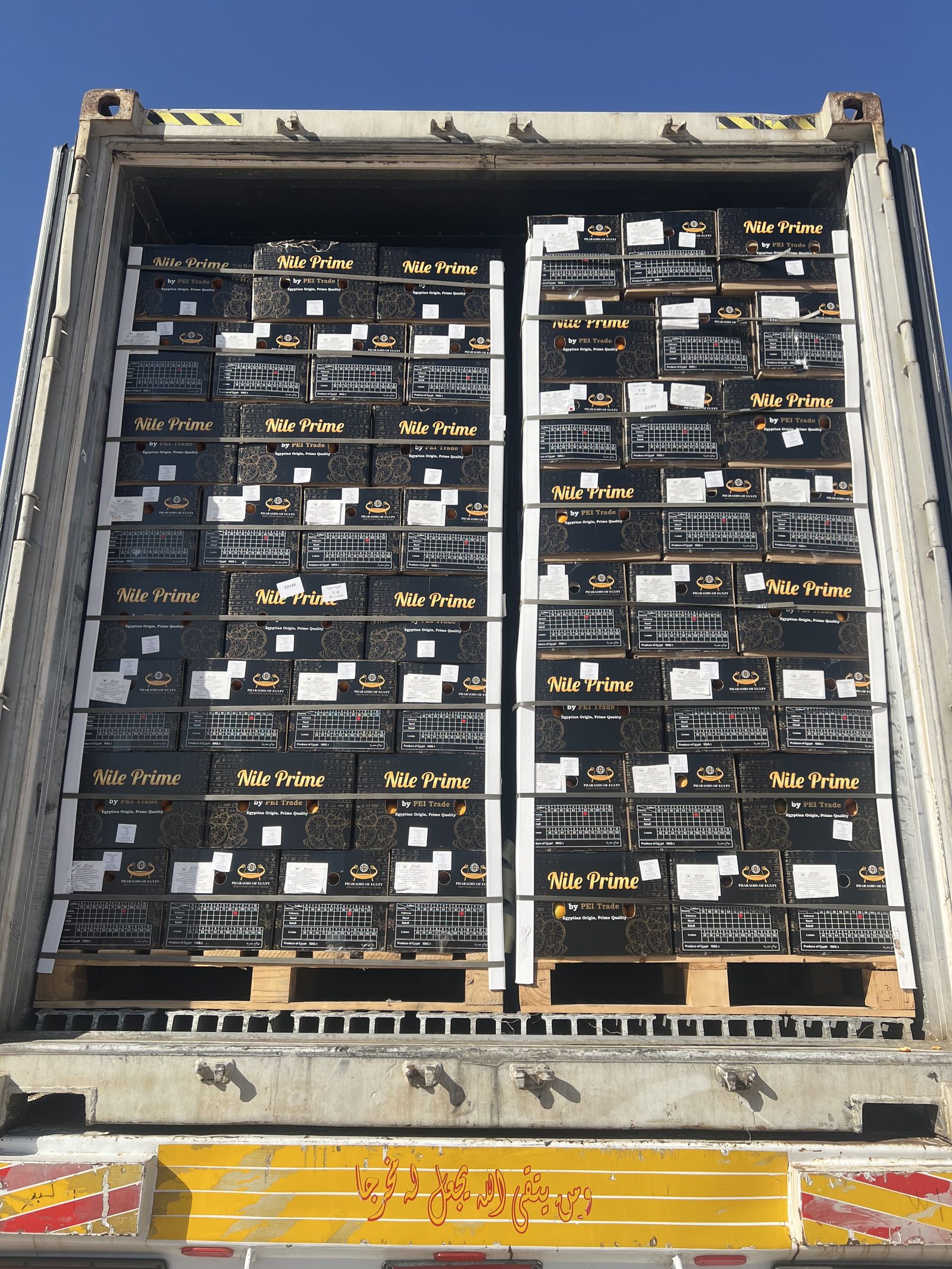
Citrus is the second group and is why the 2026/2027 window matters now. Valencia and Navel oranges hold well at 4 to 6 degrees Celsius, and the Egyptian season from December through May aligns with the period when regional supply is thinnest. Mandarins are more fragile and better suited to the shorter Georgian and Azerbaijani legs. Sizing and half-pallet options are set out in our guide to Egyptian citrus in part-loads.
Frozen and dry goods are the third. IQF strawberry, okra and molokhia, dates, legumes and dried herbs are indifferent to transit length and are the safest first order for a buyer testing a new lane.
Documents and clearance
The base document set is unchanged: invoice, packing list, certificate of origin, phytosanitary certificate and the transport document. What differs is that goods cross more than one customs territory, so a transit declaration is usually needed for the overland leg. Several destinations in the region also require the certificate of origin to be legalised, and some apply their own conformity or registration requirements on food imports. Establish which apply to your country before the goods load, because a document that must be legalised in Cairo cannot be fixed once the container has sailed.
Structuring a first order
Given the transit length, we suggest a first order that mixes a durable anchor product with a smaller trial quantity of whatever you actually want to build the programme on. A pallet of onions or dates alongside a few pallets of oranges gives you a real arrival to assess without exposing much value. Minimum quantities by product are listed in our note on minimum order quantities from Egypt.
Payment on these lanes is normally a deposit with the balance against documents, since letters of credit add cost and time that rarely suit a part-load. Agree the split before the goods are packed.
Peivana builds mixed and part-load containers from Egypt for mid-size importers, with GLOBALG.A.P and BRC certified suppliers and same-day quotes. To discuss a first shipment into Georgia, Azerbaijan, Kazakhstan or Uzbekistan, message us on WhatsApp at +20 10 9911 1918.