
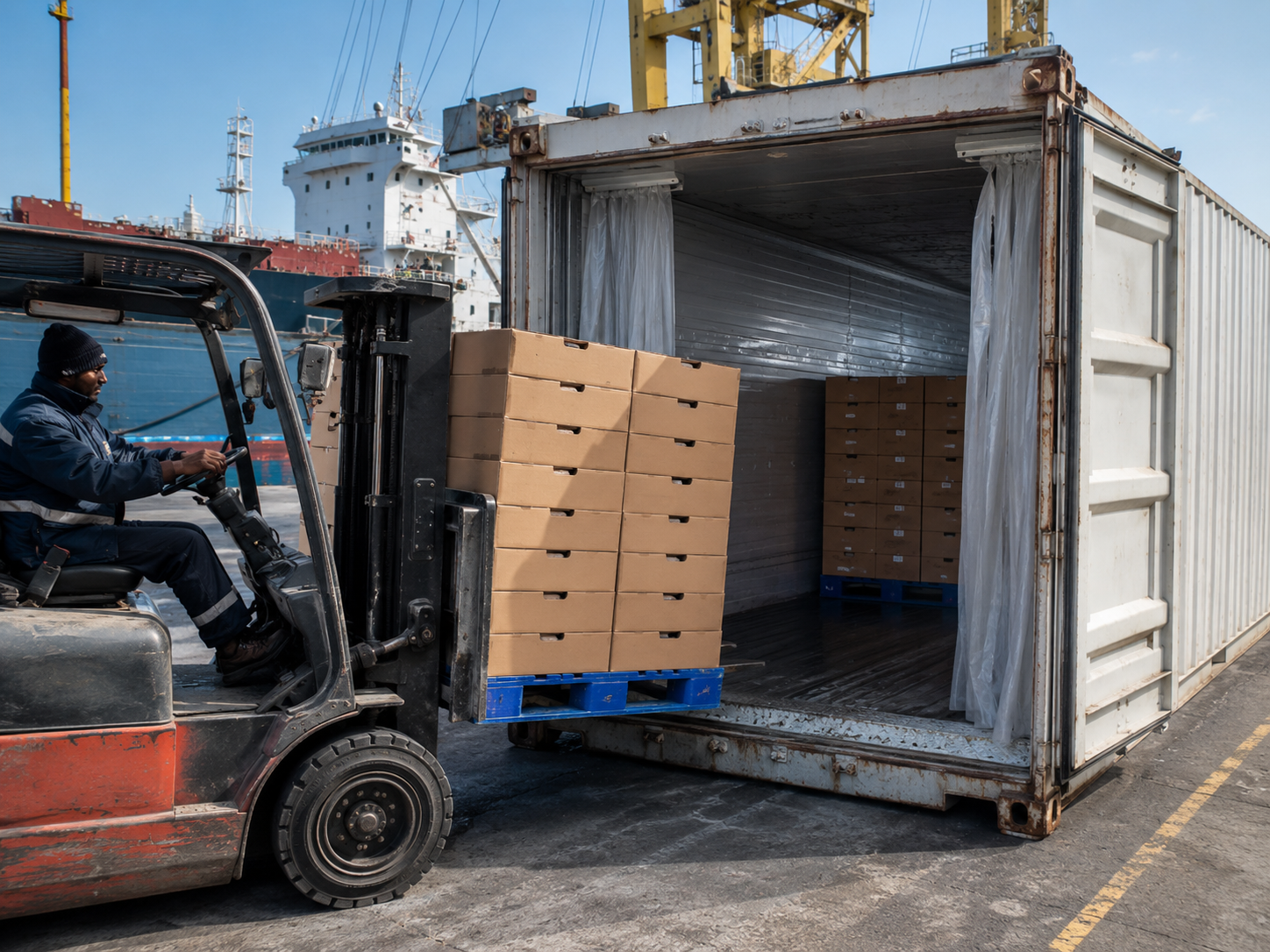
A mixed container only saves money if everything inside it arrives in the condition you sold it in. The container runs at one set point, has one relative humidity and one air exchange rate. Every product on board has to be able to live with those settings for the whole transit. That constraint, not the price list, is what really decides what can travel together.
Start with the temperature band
Group your intended products by their carriage temperature before you group them by anything else. Egyptian export products fall roughly into four bands.
Frozen product sits at minus 18 degrees Celsius and cannot share a container with anything fresh. IQF strawberry, okra and molokhia belong here and only travel with each other.
Cold chill, around zero to 2 degrees, covers pomegranate, grape, fresh strawberry, artichoke, green beans and most leafy vegetables.
Mid chill, around 4 to 8 degrees, covers citrus. Oranges and mandarins are usually carried at 4 to 6 degrees, lemons a little higher.
Warm chill, 10 to 13 degrees, covers mango, sweet potato, aubergine, cucumber and most greenhouse vegetables. Onions and garlic sit apart again at low temperature but very low humidity.
Products from different bands do not mix. A mango carried at 2 degrees will show chilling injury as sunken grey patches and off flavour. A pomegranate carried at 12 degrees will arrive with the calyx already colonised by mould. There is no compromise set point that works for both.
Ethylene, the second filter
Once the temperature band is settled, check ethylene. Some products give it off in quantity and others react badly to it. Mango and melon are strong producers. Leafy vegetables, green beans, cucumber and artichoke are sensitive and respond by yellowing, softening or developing russet spotting.
Citrus is a moderate producer and is also sensitive to the ethylene of others, which is one of several reasons citrus is normally shipped as a single product load rather than mixed. Onions and garlic are neither producers nor especially sensitive, but they carry odour that transfers readily into any product with a high surface area.
Odour and moisture transfer
Odour is the failure mode buyers forget. Onion and garlic will scent strawberries, herbs and any product packed in a permeable film. Keep them out of mixed loads with soft fruit entirely, or ship them as a full single product load.
Humidity works the same way. Onions and garlic need 65 to 70 percent relative humidity and will pick up moisture and start sprouting in the 90 to 95 percent that leafy vegetables require. Two products that look compatible on temperature can still be incompatible on humidity.
Combinations that work in practice
Pomegranate with grape and fresh strawberry works at 0 to 2 degrees, provided the strawberry is well pre-cooled and positioned for airflow. Sweet potato with aubergine and cucumber works in the 10 to 13 degree band. Mango can share the warm chill band with sweet potato but should not travel with cucumber or green beans because of ethylene. IQF products travel together and with nothing else.
Where mixing is genuinely not possible, the practical answer for a mid-size buyer is to split across two shipments rather than compromise the set point. Our note on shelf life by product on Egyptian mixed loads covers how to sequence sell-through when you do that.
Loading order and airflow
Within a compatible mixed load, position matters. Pallets go on the T bar floor with the channels clear, no pallet blocks the delivery air at the front bulkhead, and nothing is stacked above the red load line at the rear. The most temperature sensitive product goes nearest the delivery air. Products packed in solid walled cartons need vent holes aligned in the stack direction, not against it.
Requesting a temperature logger per product group rather than one per container is worth the small extra cost on a mixed load, since a single logger at the door tells you nothing about the pallet at the front. The practicalities are covered in our guide to temperature loggers on Egyptian part-loads.
Building your load
Peivana builds mixed containers from GLOBALG.A.P and BRC certified Egyptian suppliers and checks compatibility before quoting rather than after loading. If a combination will not travel, we will say so and propose an alternative split.
Send your intended product list, quantities per line and destination port to our export team on WhatsApp at +20 10 9911 1918 and we will come back with a compatibility check and a same-day quotation.