
Onion and garlic part-loads are the one product group where the standard mixed container rules work against you. Onions and garlic need dry air, ideally 65 to 70 percent relative humidity. Almost every other crop in an Egyptian mixed reefer wants 90 to 95 percent. Put a half pallet of mesh-bagged onions next to citrus and greenhouse vegetables at a shared set point, and the bulbs pick up moisture, the necks soften and neck rot appears within a week of arrival. The crops are perfectly loadable in small quantities. They just need to be positioned and packed for the conditions they are actually going to meet.
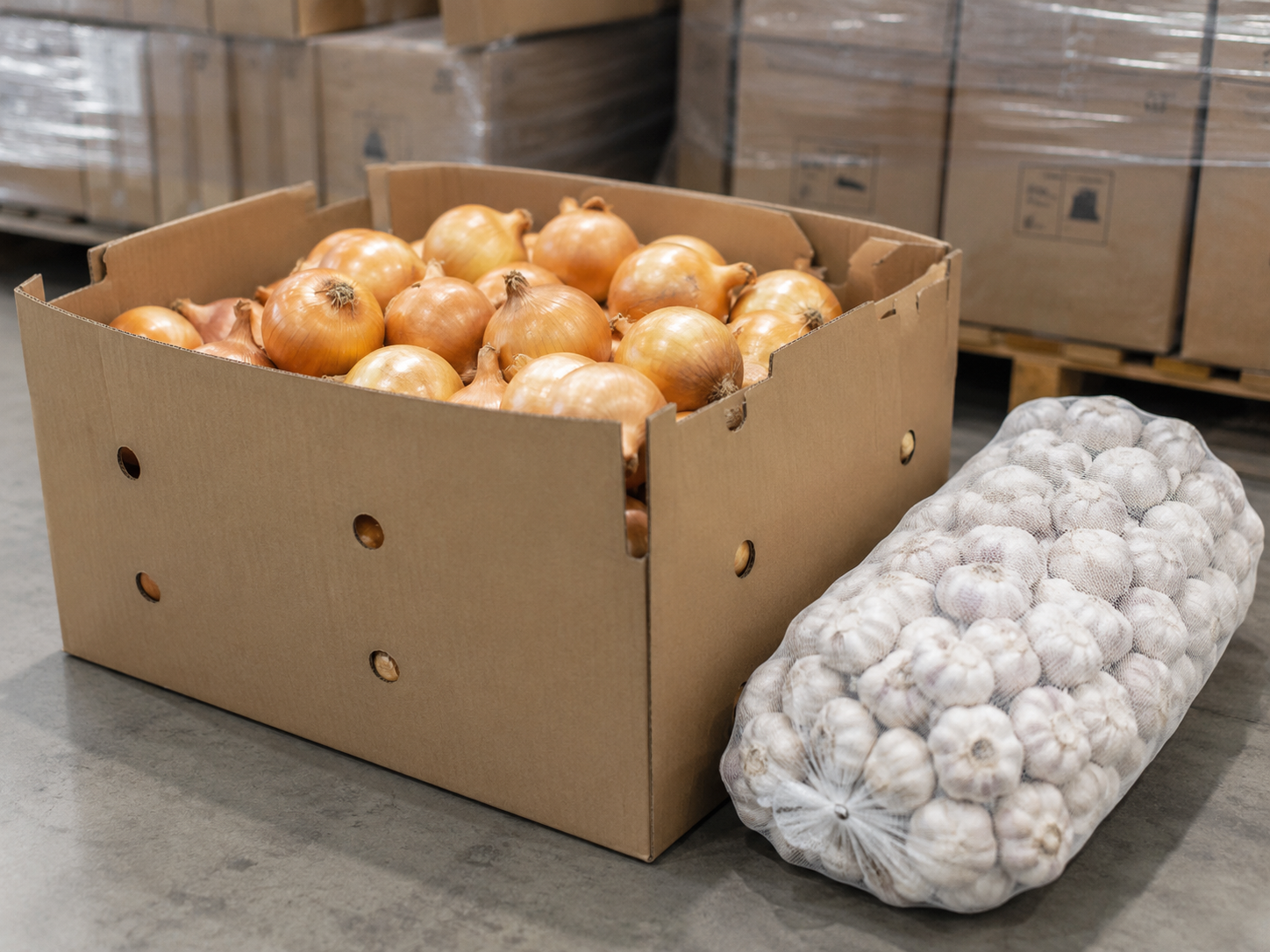
What a half pallet actually holds
| Product | Usual pack | Half pallet, approx | Humidity it wants | Mixed with fresh fruit |
|---|---|---|---|---|
| Golden onion | 25 kg mesh bag, or 10 kg ventilated carton | 500 to 600 kg | 65 to 70 percent | Only in cartons, only short transit |
| Red onion | 25 kg mesh bag, or 10 kg carton | 500 to 600 kg | 65 to 70 percent | Only in cartons, only short transit |
| White garlic | 10 kg carton, or 5 kg net | 400 to 500 kg | 60 to 70 percent | Yes in cartons, keep off the floor |
| Peeled or prepared garlic | Vacuum or modified atmosphere pouch | 300 to 400 kg | Sealed, not applicable | Yes, chilled and sealed |
The humidity problem, and the three ways round it
There are three workable answers when you want onion or garlic in a shared Egyptian container. The first is to take the product in ventilated cartons rather than mesh bags. A carton gives the bulbs a physical barrier against condensation dripping from the fruit above and from the container ceiling, and it stacks cleanly on a half pallet. It costs more per kilo than mesh and it is worth it on a mixed load.
The second is position. Ask for the onion or garlic pallets to be stowed at the door end, away from the delivery air and away from the wettest part of the load. The door end runs warmer and drier, which is a defect for fruit and an advantage here. The third is transit length. On a seven to ten day Mediterranean or Gulf routing, a carton of onions in a fruit reefer arrives sound. On a twenty day sailing it does not, and at that point onion should be booked as its own dry container or dropped from the mix.
Ask one question before you order: is it fully cured
Every onion arrival problem on a mixed load traces back to one of two things, humidity or incomplete curing. A properly cured onion has a dry, tight, papery neck and a firm shoulder. An under-cured onion has a slightly green or soft neck and will rot from that point regardless of how well the container is stowed. September and October fruit comes out of storage, so ask the supplier directly how long the lot was cured and where it has been held since. It is a fair question and a real exporter answers it in one line.
Building the rest of the load around it
The best companions for an onion or garlic half pallet are other low-moisture products. Dates in cartons, dried herbs, pulses and packed dried goods all sit comfortably at the same conditions and none of them are ethylene sensitive. The worst companions are leafy product and anything under film, because both raise the moisture load in the box. Our reference on temperature and ethylene compatibility in a mixed Egyptian reefer gives the full compatibility picture, and pallet space planning in a mixed reefer covers how many half pallets you can fit and what each one costs.
Peivana is an Egyptian exporter and consolidator, not a neutral adviser. Pallet weights above are working figures and vary with bulb size, pack format and pallet height. Confirm the exact configuration on your own order before you calculate landed cost.
Adding onion or garlic to your next mixed container
Tell us the destination port, the transit time and what else is going in the box, and we will tell you whether onion or garlic belongs in that container or needs its own booking. Quotes go out the same working day. WhatsApp +20 10 9911 1918.