
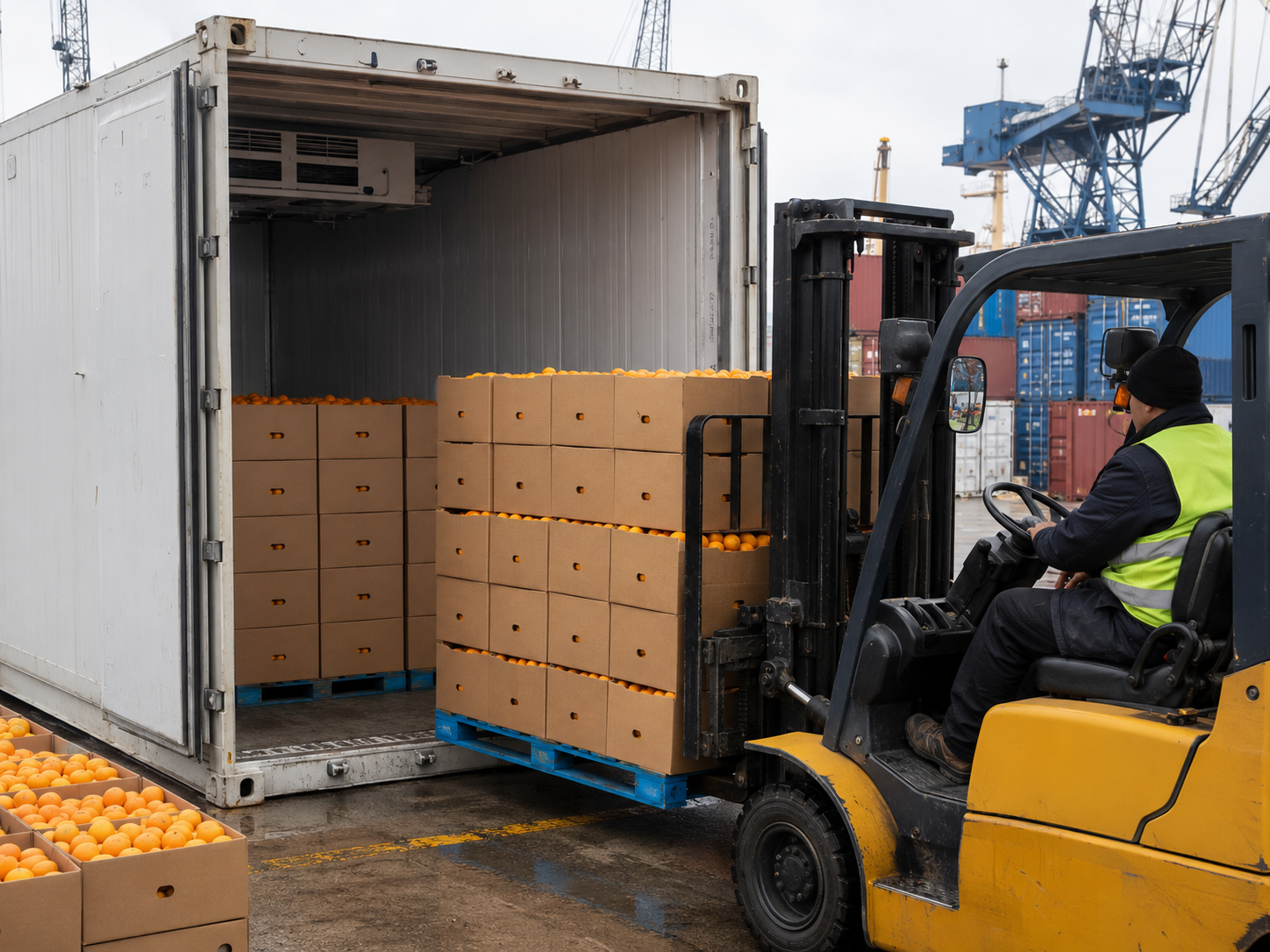
Egyptian citrus part-loads let a mid-size buyer take one or two pallets of Navel, Valencia or Murcott instead of committing to a full reefer. The citrus season runs from roughly December to May depending on variety, it is the longest and most reliable window Egypt has, and it is the easiest category to combine with onions, pomegranate and root crops in a single container at one set point.
Variety windows and what to book when
| Variety | Loading window | Common carton | Typical sizes |
|---|---|---|---|
| Navel orange | December to February | 15 kg telescopic | Counts 48 to 88 |
| Valencia orange | February to May | 15 kg telescopic | Counts 56 to 113 |
| Murcott mandarin | January to March | 10 kg or 9 kg | Sizes 1XXX to 4 |
| Adalia lemon | September to March | 15 kg | Counts 100 to 165 |
| Grapefruit | December to March | 15 kg | Counts 27 to 50 |
Navel is the opening variety and the one that sells on appearance. Valencia is the workhorse and the better choice for juice and for markets where transit is long, because it holds condition longer. Murcott is the premium easy-peeler and the line most often taken in small quantities, since a single pallet covers a specialist retailer for several weeks.
What a citrus part-load actually looks like
A standard Egyptian citrus pallet is built on a 100 by 120 cm base and carries in the region of 70 to 80 cartons of 15 kg, so roughly 1.0 to 1.2 tonnes per full pallet. A half pallet is the smallest unit that ships without losing stability in a shared container. For a mid-size buyer that means a workable minimum of one pallet per variety, and a practical mixed load of two to four citrus pallets alongside other winter products.
Exact carton counts per pallet depend on the carton height and the pallet height limit your destination accepts, so always confirm the configuration on the offer rather than assuming. Our note on pallet space planning in an Egyptian mixed reefer works through how many half pallets fit and what each one costs.
What citrus can share a container with
Citrus carries at 4 to 8 degrees Celsius depending on variety and destination, which places it in the same broad band as pomegranate and grape, and close enough to onions and root crops for a shared set point to work with a small compromise. Citrus is not ethylene sensitive in the way that some vegetables are, but it does absorb odours, so it should not travel next to onions or garlic without separation. The compatibility rules are set out in our guide to mixing products in one Egyptian reefer.
Peivana is GLOBALG.A.P and BRC certified at source and issues certificate copies with the shipping file, which matters more on a part-load than on a full container because the paperwork covers several buyers.
Peivana is the exporter, not a neutral market reviewer. Windows above are indicative for the 2026/2027 season and shift with the weather in any given year.
Get a citrus part-load quoted the same day
Send the variety, size, number of pallets, destination port and Incoterms 2020 basis, and we will come back with a price and a loading week. WhatsApp +20 10 9911 1918.